One Story, Two Accounts: A Reader’s Comparison Routine
Compare two accounts of the same issue without rushing to a verdict: separate shared facts, distinct claims, and unanswered questions in a clear routine.
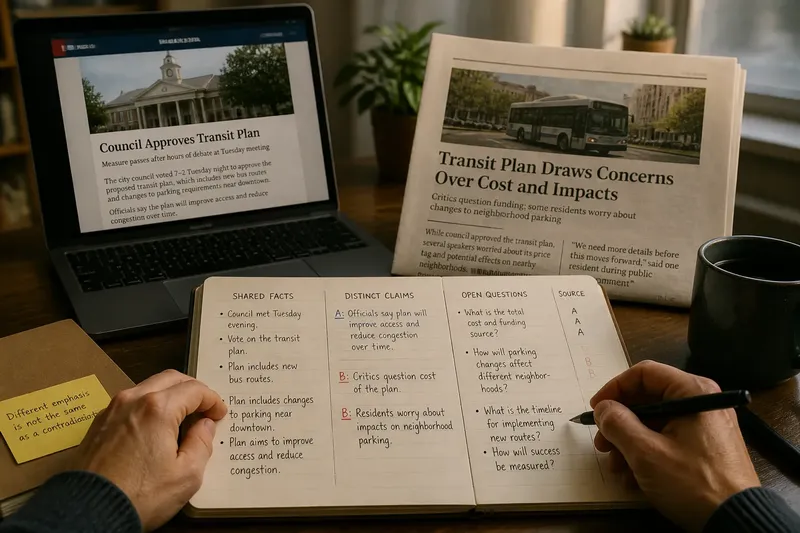
Comparing two accounts of the same issue works best when you keep a simple record of what they share, what each claims, and what neither answers. That routine helps you notice real disagreements without treating every difference in emphasis as a contradiction—or forcing a verdict before the evidence is clear.
Set aside a little space on paper or in a notes app. You do not need a spreadsheet, a scoring system, or a declaration about which outlet you trust more. The point is to compare the accounts themselves, claim by claim.
Choose Comparable Accounts
Start with two accounts that address the same event, decision, or public claim. They do not need to be identical in format, but they should overlap enough to compare: two news reports about a council vote, for instance, or a report and a public statement about the same policy announcement.
Check that both refer to the same time and version of events. One account may describe an early proposal while the other covers a later decision. If the subject has changed, note that first; otherwise, you may mistake a timeline difference for a dispute.
Keep the comparison narrow. If one story covers a vote and its local effects while another focuses on the broader policy, identify the shared point you can actually examine. You can compare their accounts of the vote without pretending they set out to answer the same larger question.
Set Up Three Columns
Make three columns labeled “Shared facts,” “Distinct claims,” and “Open questions.” Add a fourth column for source or location if you want to track where each point appears. In a document, a basic table works; on paper, three headings and a few lines beneath each are enough.
Write short, neutral entries rather than copying dramatic wording. “The proposal passed at the meeting” is easier to compare than a headline’s description of a “sweeping victory.” If an exact phrase matters to the argument, put it in quotation marks and record which account used it.
Keep the accounts separate while taking notes. Mark them “A” and “B,” and attach the letter to every distinct claim. That small habit prevents a point from one report from quietly appearing in your notes as something both reports established.
Record Shared Facts
Read each account once for the basic sequence: who acted, what happened, and what decision or statement is being discussed. Then list only the points both accounts state in a comparable way. Shared details might include the date of a meeting, the text of a motion, or the fact that a named agency issued a statement.
Use careful wording. If both accounts report that officials announced a review, record that an announcement was made—not that the review has already produced a result. Shared reporting can establish what each account says, while the meaning or consequences of the event may remain disputed.
Do not add a point simply because it feels obvious or appears in background you already know. A comparison is more useful when each entry can be traced to something in both accounts. If one says “the board approved the plan” and the other says “the board voted on the plan,” check the surrounding text before calling those statements equivalent.
Separate Distinct Claims
Next, note claims that appear in only one account or are framed differently. Label who makes the claim: a reporter, an official, a critic, a named organization, or an unnamed source. “The agency says the change will shorten delays” is not the same as “the change will shorten delays.” The first attributes a prediction; the second presents it as a fact.
Look for differences in scope as well as outright disagreement. One account may describe effects on a particular neighborhood, while another discusses the whole city. One may quote supporters at length and the other may give more space to opponents. Record those choices as differences in coverage, not as proof that either account is false.
Say you are comparing two reports about a school board’s proposed boundary change. Both state that the board released a draft map. Account A says families near one school worry about longer commutes; Account B quotes officials who expect enrollment to become more balanced. Your notes can preserve both claims and their speakers without treating either prediction as settled or deciding that the accounts directly contradict each other.
Mark Open Questions
Use the third column for information that would help clarify the accounts but is missing from both. Ask what a reader would need to understand the difference: the exact wording of a proposal, the time period behind a forecast, the people included in a count, or the response from someone named as affected.
Keep an open question distinct from a suspicion. “Does the draft map include the new apartment complex?” is answerable. “Are officials hiding the real reason?” assumes a motive that the accounts may not establish. When you cannot frame a question without building in an accusation, rewrite it around the missing fact.
Some questions will remain open because the accounts have different aims or because the relevant information is not yet available. Leave them marked as open. A blank space is more honest than an invented explanation.
Check the Disagreement
Before drawing a conclusion, compare entries side by side and ask what kind of difference you see. Is it a factual conflict, a difference in attribution, a prediction, a variation in emphasis, or simply a detail reported by one account? Naming the type can prevent a narrow disagreement from turning into a broad verdict about the whole story.
For a factual conflict, locate the exact sentences and check whether they refer to the same event, people, and time period. For competing predictions, record who expects what and on what stated basis. For different emphasis, note what each account foregrounds and what it leaves out; do not call that a factual contradiction unless the claims actually conflict.
You can make a small final note such as “shared event, different forecasts, outcome unresolved.” That is a useful result, not a failure to decide. It says what the comparison supports while leaving room for information that may arrive later.
Questions That Clarify?
What if one account is much longer?
Compare the overlapping claims, not the total amount of material. If the shorter account omits a point, list it as present in only one account rather than treating its silence as disagreement.
Should I decide which account is more credible?
You can assess a specific claim’s support, attribution, and precision, but avoid turning one comparison into a blanket ranking of outlets. A useful note identifies what each account establishes and where its claims remain uncertain.
What if the accounts contradict each other?
Write both statements in parallel and check whether they describe the same thing under the same conditions. If they still conflict, record the unresolved point and the information that could distinguish between the accounts.
Can I compare a news story with an official statement?
Yes, if both address the same issue, but note their different purposes and speakers. An official statement may explain an institution’s position, while a report may include additional voices or context.
Keep the Record Modest
When you finish, read your notes as a record of the comparison, not a verdict on the entire issue. The result may be a clear shared account, a set of competing claims, or a short list of questions that neither story settles. Any of those outcomes can help you read the next update with more precision.
It is not worth scoring the accounts with invented points for balance, tone, or number of sources. Such a score can look decisive while hiding the very distinctions your notes were meant to preserve. Keep the labels plain and the claims traceable instead.
A careful comparison of two accounts does not require you to suspend judgment forever. It asks you to tie each judgment to a specific claim, distinguish what is shared from what is disputed, and leave uncertainty visible where the accounts do not resolve it. That is enough to make a public debate easier to follow without pretending the evidence has said more than it has.