From Source to Claim: Where the Evidence Chain Can Thin
Trace how a public claim changes from source to summary, so you can spot missing context and separate reported evidence from added interpretation.
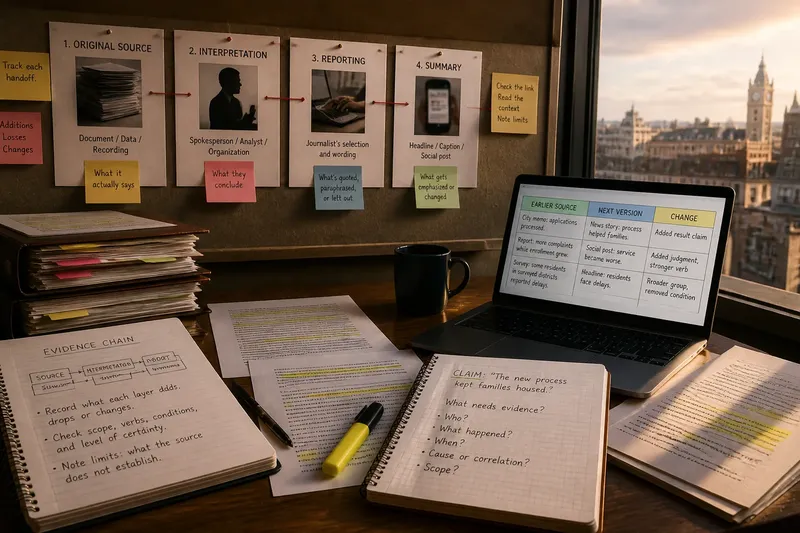
A public claim can sound more definite than the material beneath it because each retelling may remove context or add interpretation. To follow an evidence chain, trace a sentence backward from the article to the source it relies on, then mark what changed at each handoff.
This is not the same as deciding whether a story is true at a glance. It is a way to see what supports a particular claim, what the writer contributed, and what remains unverified. Even a careful report may compress a complicated source; the useful question is what that compression leaves behind.
Start with the claim
Choose one sentence that carries the story’s central assertion, rather than trying to audit every detail at once. A claim might say a policy “reduced delays,” a report “warned of a risk,” or an official “admitted a mistake.” Each phrase makes a different kind of assertion, and each needs a different kind of support.
Rewrite the sentence in plain language without changing its meaning. Then underline the parts that would need evidence: who acted, what happened, when, and whether the sentence describes an observation, a cause, or someone’s interpretation. Words such as “because,” “led to,” and “admitted” often carry more than a simple factual description.
For instance, “the agency’s new rule cut wait times” asserts both a change and a cause. A source showing shorter waits after the rule took effect might support the change, but not by itself establish that the rule caused it.
Trace each handoff
A claim may travel through several layers: an original document or recording, a person who interprets it, a journalist’s selection and wording, and a headline or social post that condenses the story. The chain is not automatically unreliable; each layer can make information easier to understand. But each can also narrow what readers see.
- Original material: What does the document, recording, dataset, or direct statement actually contain?
- Source interpretation: What conclusion does a spokesperson, analyst, or organization draw from it?
- Reporting: Which details does the story quote, paraphrase, or leave out?
- Short summary: What changes in the headline, caption, or post?
At each handoff, write down the source’s contribution and the reporter’s contribution separately. “The report lists missed appointments” is different from “the report says the program failed.” The first may describe material in the source; the second attributes an evaluation to it, so check whether the source itself makes that evaluation.
Mark additions and losses
A simple two-column note can keep the chain visible. In one column, record what the earlier source explicitly says. In the other, record what the next version adds, drops, or changes. Use brief labels such as “added cause,” “removed condition,” “broader group,” or “stronger verb.”
Suppose a public report says a service received more complaints during a period when enrollment also grew. A news story reports the increase, while a social post says the service became worse. The post has turned an observation into a judgment; the report’s enrollment context may also matter when comparing the raw complaint count.
Look especially for changes in scope. “Some residents” can become “residents”; “in the surveyed districts” can disappear; a finding about one measure can be retold as a verdict on an entire program. These shifts can happen without any sentence being fabricated. The trouble is that the resulting claim may apply to more people or situations than the source covers.
Also mark what a source cannot answer. A transcript can establish what someone said, but not whether the statement is accurate. A chart can show a pattern in the displayed data, but it may not explain its cause. A source is not a universal backing for every sentence that mentions it.
Check the link closely
When an article links to a source, open the link and locate the passage or material the story relies on. Search within a document for a distinctive phrase, then read the surrounding section. A quotation can be exact yet misleading if the sentence before it sets a condition or the next paragraph gives a qualification.
If the link leads to a long report, check its title, authoring organization, date, scope, and stated method. Those details help identify what kind of material it is and what questions it was designed to address. If a report is unavailable or the story links only to another article, note that the chain stops there; do not treat a second-hand description as though you had inspected the original.
Say you read a city news story claiming that a new application process “kept families housed,” and it links to a memo. The memo says applications were processed, but does not track housing outcomes. Your notes could mark “kept housed” as an added result claim and “housing outcomes not covered” as a limit; that gives you a precise reason to treat the wording cautiously without dismissing the memo’s contents.
It is not worth chasing every link in a long story. Follow the source behind the claim that matters to your understanding, and stop when the remaining uncertainty is clear enough to describe.
Questions along the chain?
What if the original source is missing?
Record where the trace ends and identify which part of the claim depends on a source you cannot inspect. You can still evaluate the article’s wording and attribution, but keep the underlying assertion provisional.
Can a journalist’s summary be evidence?
It is evidence of what the journalist reports and may accurately convey a source. For a claim about what the underlying document says, however, the document itself—or a clear quotation with context—offers a more direct check.
How can I spot a change in meaning?
Compare the exact scope, verbs, conditions, and level of certainty across versions. If “may affect” becomes “will affect,” or a limited group becomes everyone, mark the change rather than silently carrying the stronger wording forward.
Keep the chain visible
A useful note does not need to settle the whole story. It can say: “The source records X; the article interprets it as Y; the summary adds Z; the source does not establish the cause.” That sentence preserves both what the material supports and where the claim goes beyond it.
When you encounter a public claim, use “source to claim” as a search phrase only as a reminder to follow the wording backward, not as a verdict on its reliability. The strongest reading is often the one that can name the source, the transformation, and the remaining gap in the same breath.